News

Ophiucus for The Busy Drone and two melodic instruments

‘Ophiuchus’ (2025) is a piece for The Busy Drone and two melodic instruments, written with the support of Orgelpark Amsterdam. It will be premièred at Orgelpark on 24 January 2026 by Wilma Pistorius (cello) and Anne Veinberg (organ), together with the wonderful self-playing organ The Busy Drone. The piece will be performed again a year later, on 23 January 2027 by Anna Stegmann (recorder) and Jorge Jimenez (violin).

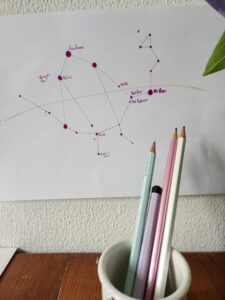
The piece is inspired by the constellation Ophiuchus, the recognised thirteenth Zodiac sign.

The Zodiac is defined as star constellations that the sun moves through. Though the Zodiac uses twelve star signs, the sun actually passes through a thirteenth constellation: Ophiuchus, the serpent bearer.

This star sign speaks to my imagination: as a 13th Zodiac sign, it fits better into the lunar calendar (with approximately 13 months) than the solar. I would thus call it a “lunar Zodiac sign”. Adding to its mystery, Ophiuchus is usually in the daytime sky, and often not visible from most latitudes, except for the Arctic during winter, and the Equator. Also, the constellation of Ophiuchus straddles the celestial equator (an imaginary projection of the earth’s equator into space), thus appearing to be a figure that moves between worlds.

The “figure” of Ophiuchus is that of a man grasping a serpent. In Greek mythology, it represents Asclepius, the god of medicine. He is depicted holding a serpent, a symbol of renewal. To honour the serpent in ‘Ophiuchus’, I used a cyclical form with material that keeps returning.

However, the figure of Asclepius the serpent collector is a very cis-heterosexual male image, and a figure I cannot relate to as a queer woman and passionate feminist.

Fortunately, ‘Asclepius’ also has a different meaning: it is also the title of a Hermetic text, attributed to the legendary Hellenistic figure Hermes Trismegistus, who is a syncretic combination of Hermes and Thoth.

Hermes is the ancient Greek messenger of the gods, who moves freely between worlds of mortal and divine, and guides souls to the afterlife. In essence, he is a figure who moves between worlds.

Thoth is the ancient Egyptian god of the moon, wisdom, knowledge, science, art, and magic. He connects to the idea of a lunar Zodiac sign, and the whole field of understanding stars in the first place.

Thus, I took the liberty to making Hermes Trismegistus the figure of my 13th Zodiac sign, Ophiuchus (instead of the Greek god Asclepius). He is a liminal being, moving between worlds, occupying both sides, straddling the threshold – just as the star constellation Ophiuchus straddles the celestial equator. What Hermes Trismegistus represents, is the poetic essence of the piece: ambiguity, mystery, fluidity, and contradiction. This is also consonant with the idea of a lunar Zodiac sign (because it is the 13th Zodiac), that is usually (not) “visible” in the daytime sky.

The constellation of Ophiuchus contains 13 named stars. I translated four of these into important musical material, for the mose important musical themes.

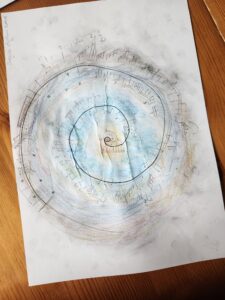
  • Rasalhague is the brightest star in Ophiuchus. The name is Arabic for ‘head of the serpent collector’. In my way of writing, I often make graphic scribbles that I translate into music. I translated the Arabic writing of ‘Rasalhague’ into a melody, the most important theme of the piece.
  • Barnard’s Star is the star with the largest proper motion. Proper motion is an astronomical concept that expresses how much a star appears to move in relation to other stars. Barnard’s Star actually moves around in the constellation Ophiuchus (as seen from Earth). The material associated with Barnard’s Star moves between sound sources during the piece.
  • Kepler’s Nova appeared in Ophiuchus in 1604. It’s intriguing that it has only become part of the constellation relatively recently. The musical material associated with Kepler’s Nova only appears later on in the piece, about halfway through. The star Kepler’s Nova is a supernova: it started out very bright in 1604 (so bright that it was visible during the day for three weeks), and continues to fade with time. What we see at the moment is only remnants of the supernova. The musical material associated with Kepler’s Nova thus starts out bright (in the foreground, clearly defined) and fade each time it comes around (softer, more fragmented).
  • Yed Prior/Yed Posterior is a pair or stars that form an ‘optical double’. This means that they seem to be located next to one another as seen from Earth, but are not physically related and appear double only because of perspective. For this theme, I used two melodies that coincide to create one theme. In order to strengthen the feeling of an optical illusion, this theme is in odd meter. The melodies also appear separately from each other in different parts of the piece.

In order to ‘create’ the figure of Hermes Trismegistus with these ‘stars’ (musical material), the theme of Rasalhague is inspired by the character of the Egyptian god Thoth.
The theme of Yed Prior/Yed Postrior is inspired by the character of the Greek god Hermes. Because Hermes is an ambiguous figure, this theme is in odd meter and somewhat playful, almost a dance.

These two themes are superimposed on each other at important points in the piece, to “create” the combination of Hermes + Thoth = Hermes Trismegistus. At other points in the piece, the themes sometimes alternate, overlap and/or interact, like stars orbiting each other and moving around in a constellation.
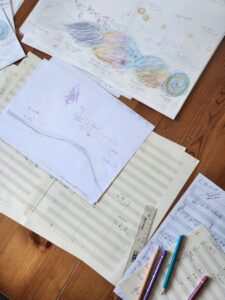
In order to create a background for these themes and loops, the piece has a musical layer of a harmonic background. This is mostly in the Busy Drone part and sometimes joined by the instruments to create more depth. The harmonic background undergoes a “progression”, not as much a progression of individual chords, but rather a progression of clouds of colours/harmonies. The progression of “pitch colour clouds” is based on the succession of the following images:

  • Stars in the daytime sky, a bright sound field with a sense of mystery and ambiguity
  • The southern hemisphere night sky, a vivid image in my mind, from spending gloriously dark nights in the mountains in South Africa as a child
  • Dark Horse Nebula, a deep sky object in the constellation of Ophiuchus
  • Pipe Nebula, a deep sky object in the constellation of Ophiuchus
  • Little Ghost Nebula, a deep sky object in the constellation of Ophiuchus

I translated each of these ‘images’ into pitches through an intuitive and synesthetic process. I have a form of synaesthesia that is not directly visual, but gives me a very strong association between colours and pitches. I also have a strong association between visual or perceived tensions and intervals (=tensions between notes). This allows me to make a musical “translation” of sensory information and the effect it has on my inner landscape.
Composer in Residence at Dag in de Branding festival

Delightfully, I am composer in residence at Dag in de Branding festival for the seasons September 2025 – May 2027!

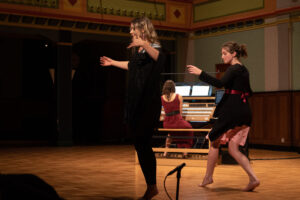
I will be creating a music theatre piece or opera, for six musicians, an opera singer (Antje Lohse), a dancer (Xolani Mdluli), and an actor (Lucia Zemene). The piece revolves around themes I care about: gender- and cultural identity and equality.

In essence, it’s a piece about different forms of communication: learning to understand each other even if you express yourself in different ways. There is a split in disciplines: initially one character expresses themself only in dance (dancer), one only in music/vocals (singer), one only in text (actor). The build-up is that the characters don’t understand each other at first, learn to understand each other, and find out that they are saying the same thing. Or perhaps not exactly the same, but with strong common ground.

The story is a kind of fairy tale, newly written for the project by Maaike Haneveld. I won’t write the music on a pre-existing libretto, as is the conventional approach; instead we will start by creating the characters together, also based on input from the performers. The characters all have their own characteristic musical style.

Although I want to address social inequalities with this piece, I won’t do so by naming them, but rather by showing a positive example of how things can be different, in a story with interactions that are not defined by conventional gender roles and ideas about skin colour.

It is a story in which a wise woman (singer Antje Lohse), a non-binary/queer character (actor Lucia Zemene) and a black character (danser Xolani Mdluli) have equal roles and achieve something good together. The story is set against a backdrop of disillusionment and a sense that the world is falling apart, but is nevertheless optimistic.

To explore this, I will start by writing one shorter piece per character, featuring only this character and two instruments. These will be presented on 30 May 2026 in Splendor, Amsterdam.

In ‘tutti’ sections later on, interactions between the different characters and their art forms can emerge.

’40 Ways of Being (a Woman)’

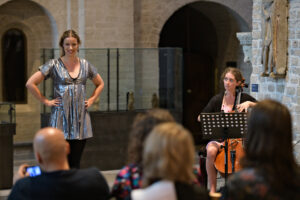
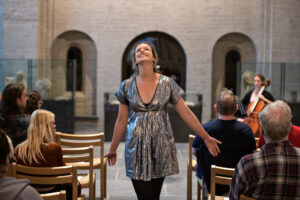
’40 Ways of Being (a Woman)’ is an electro-acoustic piece for soprano, cello, organ, and electronic soundscape, composed by myself (Wilma Pistorius) and Andrea Guterres in 2022.

Is is performed by Viola Blache (soprano), Lisi Hubmann (organ), and Wilma Pistorius (cello).

The instrumentation of the piece (organ, cello, soprano, electronic soundscape) combines the historical colours of the organ with the modern sounds of electronics. The cello forms a link between old and new, and connects the more spacious sounds of organ and electronics to the soprano.

Musically, the piece is written in a layered way, with melodies weaving through a background soundscape. The large form of the piece is based on a succession of different moods, each connected to the storyline: contemplative/vulnerable, ritualistic/dark, raw/powerful, uncertain, depressed, afraid but brave, playful/flirtatious, sassy, magical/wondrous, joyful/sophisticated. In non-musical terms, I would describe the piece as atmospheric, dark, and playful.

’40 Ways of Being (a Woman)’ is a piece about real-life things, based on personal experience: the vulnerability and curiosity of exploring your identity, being powerful and owning your space, the pain and anger of being pathologised for being free, threats of sexual violence and wanting to not be afraid of those, the joy of having a body, the fun of being sexual, the excitement of expanding one’s sexual orientation, and finally, being unapologetic and uncomproposingly authentic, and embracing your personal power.

’40 Ways’ is a piece about identity: discovering and inventing myself as a woman, reconnecting with important aspects of myself that were lost because of negative experiences.

I wanted to make something that reflects what a woman is really like, as opposed to the unrealistic images sketched by our culture. In representations of women, there are mostly two types: the suffering woman who is beautiful and gets in trouble because of it; who isn’t sexual of herself but has sexuality inflicted on her. And there is the woman who is independent and powerful, maybe even sexual, and depicted as unnatural, unfeminine, and monstrous. This is not a realistic representation. The human experience is so much more varied! I wanted to show what being a woman is really like, from my own experience, in the hope of offering a voice of sanity and woman-positivity.

As such, ’40 Ways’ definitely as an activist undertone to it. It feels a bit subversive in that it contradicts the cultural message of what being a woman is about, and offers something more personal and authentic. I think it is very important to do this. We need to show people what being a woman is really like, so that others can have the freedom to simply be themselves.

Female empowerment is important to me in the work I make. It is of central importance to me in my life, and this is reflected in my work. But I don’t always have the opportunity of expressing this in a piece: sometimes I just have to make a piece about something else. I enjoy that too. But the works that really feel close to the bone, that I enjoy making most, always contain some aspect of feminism.

I hope that this piece will give audiences some positivity, and the idea that being a woman is something joyful, something to celebrate, instead of something oppressive or burdensome (as we are often led to believe). I would also like to invite my audiece to reflect on their ideas about gender and what those are based on, and perhaps arrive at a fresh perspective. The title has a tongue-in-the-cheek irony to it: there is not one way of being a woman, and many more than 40!

‘Play/Space’

‘Play/Space’ is a new piece (ca 30′) for recorders and panflutes, performed by Juho Myllylä and Mariana Preda. It combines composed material with improvisations, and involves the audience in an interactive performance.

For me, writing music is a way of sharing positivity and inspiration with others, of communicating something from one human being to another. I would describe my music as “serious, but with a wink”. Serious, because it comes from a personal and authentic place and reflects larger philosophical questions. At the same time, I want to present these things in a playful way, and invite the audience to relate to my music in a personal way, hence the “wink”.

With ‘Play/Space’, I want to create space for creativity and spontaneity. I want to create a situation in which the musicians can interact with my (composed) material. This meant including free parts and improvisation. I also want to involve the audience by giving them a more active role in the performance. I’ve noticed that audiences don’t always know how to listen to contemporary music, and sometimes experience it as impenetrable. By making the concert interactive and literally enabling them to influence the music (or watch others do so), I want to give my audience a more concrete and hands-on experience of contemporary music, and make it something they can relate to. As a cello teacher, I enjoy taking a didactic approach to musical challenges, and involving the audience in ‘Play/Space’ is exactly this: a way of showing people how they can listen to new music.

In order to get a better idea of how I could incorporate improvisation into a composed piece, I had a closer look at some of Frank Zappa’s work. Zappa said that his solos were all about making a composition in “real-time”, where the structure is determined in advance, so he could let himself be surprised by his inspiration in the moment of performance. He would record improvised solos during live performances, and use these on composed studio albums. By analysing some of the transcriptions of Zappa’s solos (made by Steve Vai in ‘The Frank Zappa Guitar Book’), I got an idea of how Zappa built up his solos, and how he combined composed and improvised material.

Medieval music was another source of information and inspiration for the more freely notated parts of ‘Play/Space’. In Medieval music, playing together is approached in a more horizontal and less precise way than in our music today. Studying some examples of Medieval music notation gave me ideas for how I could structure and notate more aleatoric parts of the piece.

‘Play/Space’ has different kinds of sections: composed, aleatoric, and improvised. The composed parts are written and performed in the traditional way, where the musicians simply play my notes. In other parts the notation is freer, and I give the musicians some material to play around with. The piece climaxes in a large improvised section, where I sketch the outlines and provide minimal material for the musicians to interact with. The piece concludes with composed material, where I tie all the differently coloured strings together and weave them into an ending.

Besides improvisations, the ‘Play/Space’ also has interactive parts where the audience can influence the music. Listeners can affect three different parameters: the character, the tempo, and the instrumentation. By holding up signs, audience members can determine whether the mood is mischievous, sensual, or contemplative. Others can determine who’s playing: only the recorder, only the panflute, or both. A third group can set the tempo on an old-fashioned mechanical metronome. In the beginning of the piece, one kind of influence is active at a time, and later on these are layered on top of each other, creating a climax of surprises. We are also doing a livestream, in which the online audience can influence the music through a chatbox.

Although I have used audience participation in previous pieces, this extensive set-up is new for me. I enjoy working with such adventurous musicians as Juho Myllylä and Mariana Preda, who were eager to experiment with me from an early stage in my creative process. The première was a lot of fun, and I was pleased to notice that there was a more informal atmosphere in the audience, and audience members who were simply watching and listening also seemed to feel more involved in the music. Of course, a free and experimental set-up like this requires tight playing, and Preda and Myllylä do a fantastic job of reacting to the audience, and of playing the virtuoso passages I wrote them.

To contrast with the wild and exciting ride of an interactive performance, I decided to publish a selection of solos from ‘Play/Space’, to give the purely musical material the attention it deserves. These are notated in the traditional way, and require no external input: simply a musician and an instrument. These will appear under the title ‘Spectrum’ as Open Score solos, playable by any instrument.

Throughout the rehearsal period, I’ve been making short video’s about the creative process behind ‘Play/Space’ and my collaboration with the musicians. You can check these out on my Instagram: https://www.instagram.com/wilma_pistorius/?hl=en

Composing for Amateurs Award

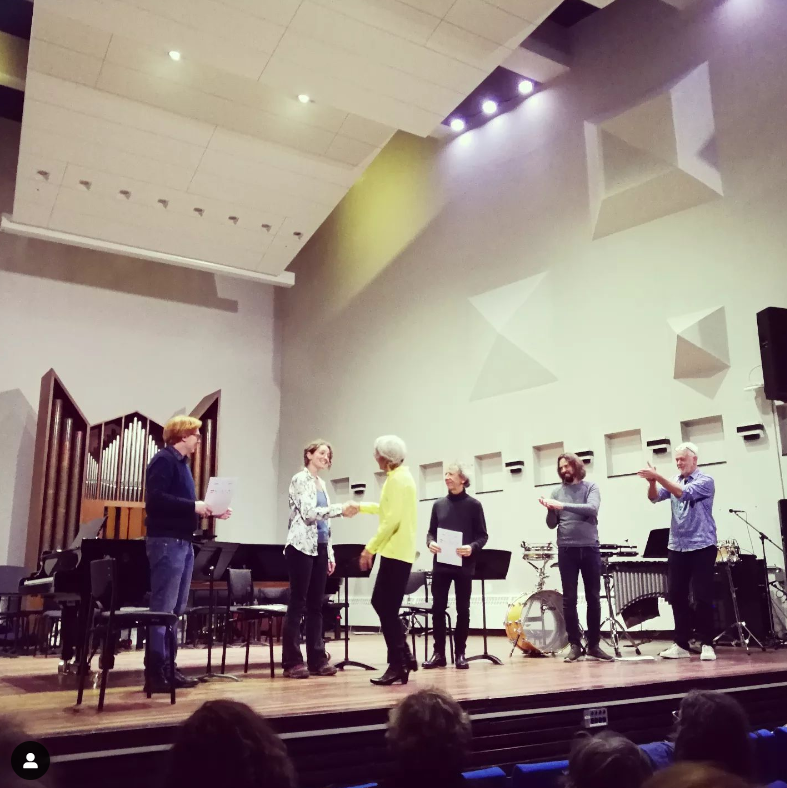
My piece ‘ǀKaggen’ (2021) for open score ensemble was awarded the first prize of CoMA Maastricht’s composition competition in Festival Nieuwe Noten! I also got to hear a great performance of my piece by an ensemble of 18 dedicated and fun amateur players. You can listen to it here.

ǀKaggen is a piece about ease and lightness, and also about mischief. It is named after a folk hero and creator god from the cosmology of the ǀXam people of Southern Africa. He is a trickster god who can shape-shift, usually taking the form of a praying mantis. The piece is not a programmatic representation of this folkloristic deity. Rather, it is inspired by what the character represents (for me): the feeling of humour and lightness that sometimes arises when we embrace the unknown, the way this ease and freedom creates space for mischief and playfulness, and an appreciation for the beauty of ordinary things. It is a piece about the fun of playing together, and the beauty of imperfection.


Moon Suite / “40 Ways of Being (a Woman)”

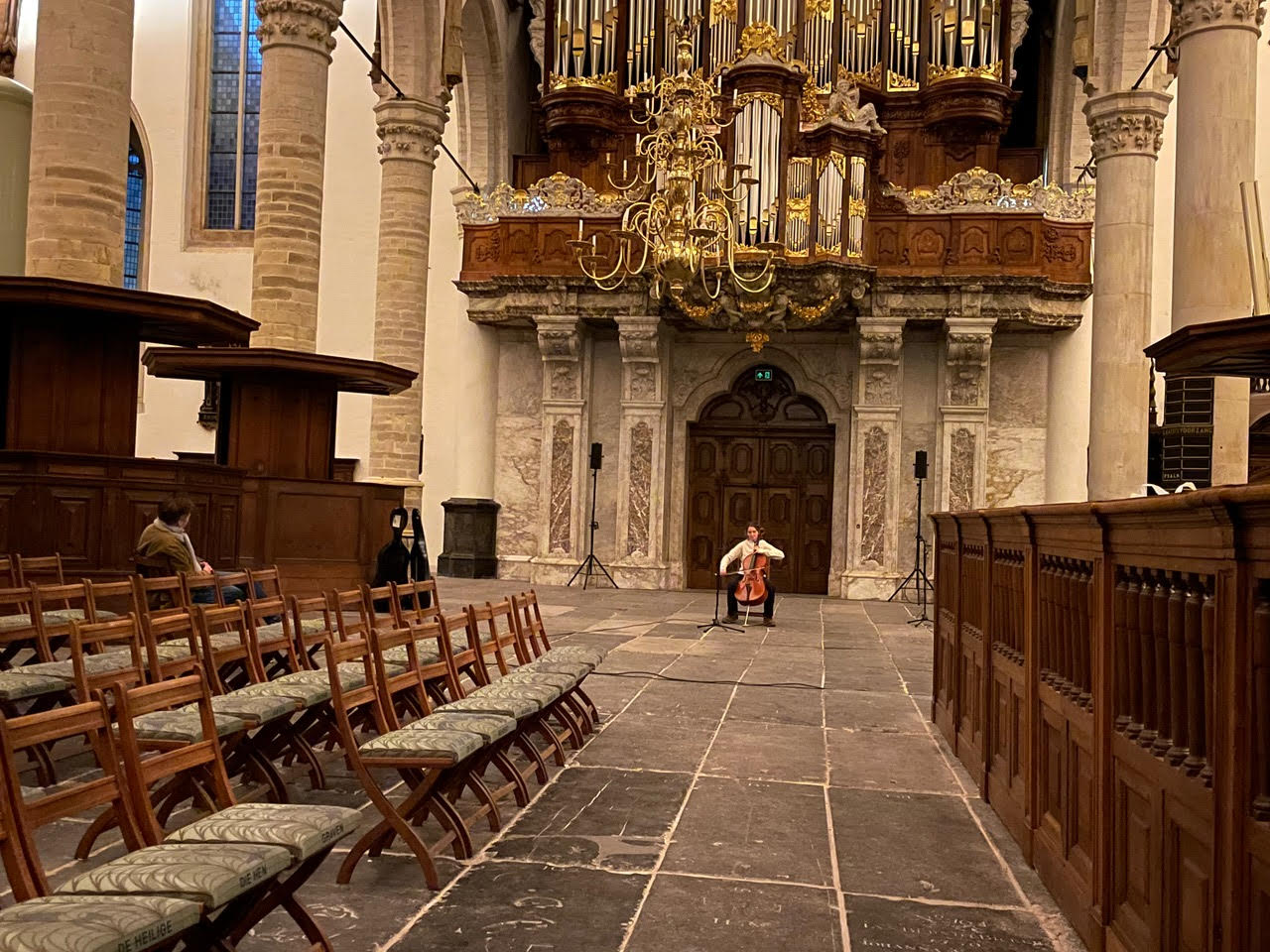
At the intersection of spring and (hopefully) post-covid renaissance, I am delighted to be playing for live audience again, in the oldest church of Amsterdam.

Playing in de Oude Kerk is almost like having a conversation with the space around me, blending with my own sound reflected off the oldest walls in town. A gorgeous acoustic is a true pleasure, and this one brings out the fragility and expressiveness of solo cello and the colours of my Moon Suite in such a way that I’m led to believe that this combination was meant to be.

The Moon Suite (solo cello, 2015) is a special piece for me: the first large work I wrote after graduating, my “coming-of-age” piece as a composer, a piece that linked two of my worlds (as a performer and creator of music). The piece is about many things, but especially about different aspects of being a woman and my experience of it. This is a theme that continues to intrigue and inspire me, and which will also form the core of “40 Ways of Being (a Woman)”.

As the name suggests, the Moon Suite is based on different moon phases – a narrative as cyclical as the reality of everyday feminine existence. In this time when the world is waking up again from a long hibernation, I am delighted to be bringing parts of it to life.

Concert on Friday 4 March 2022 8am, at de Oude Kerk, Amsterdam. https://oudekerk.nl/en/programma/silence-34-40-ways-of-being/

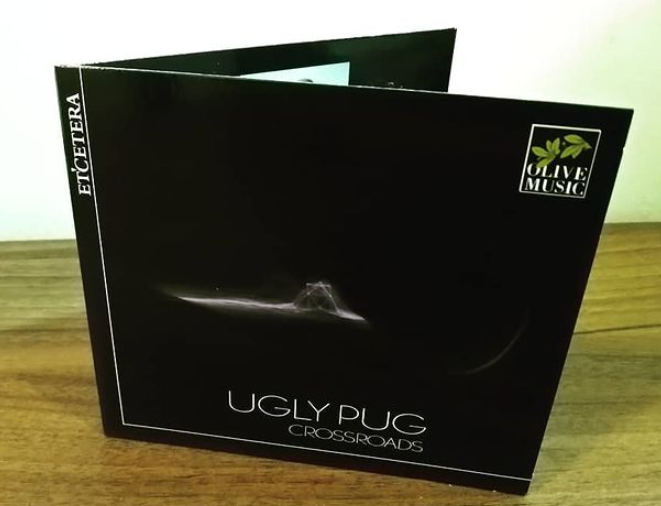
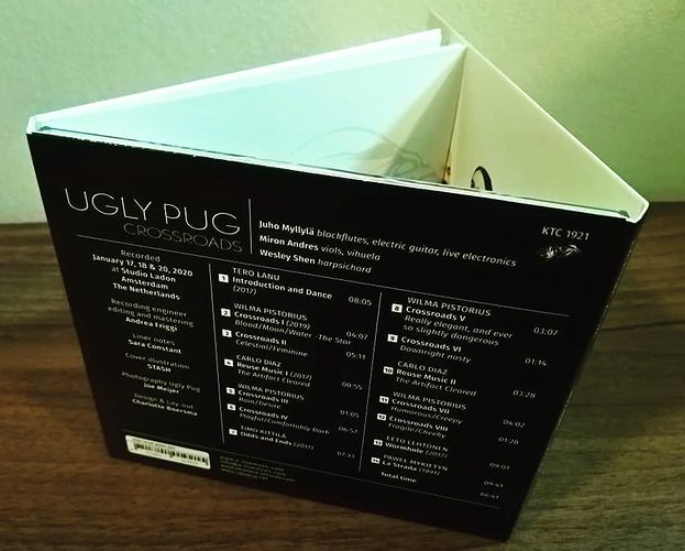
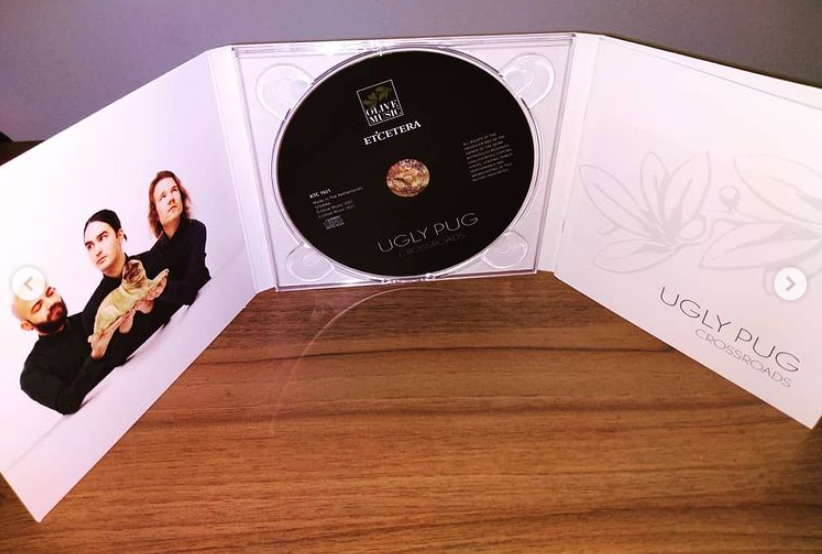
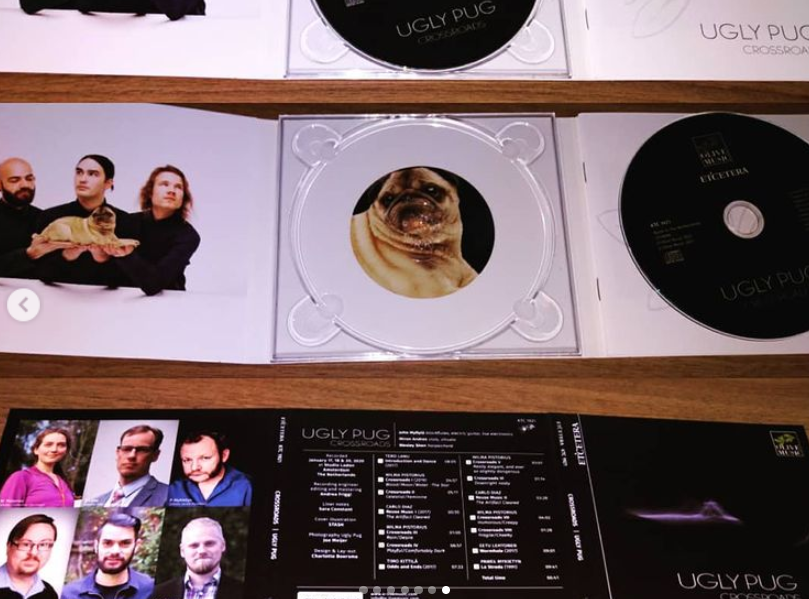
Ugly Pug / Crossroads – CD out now!

CD Digipak edition of Ugly Pug’s debut album #Crossroads (Olive Music/Etcetera Records) is now available to order here! I am delighted with this amazing recording of my work (Crossroads)by these gentlemen.

The extensive booklet includes, next to program notes and introductions of every composer, the ensemble and the musicians, beautiful and comprehensive liner notes by Sara Constant.

You can purchase or listen to it online or get a physical copy here.